
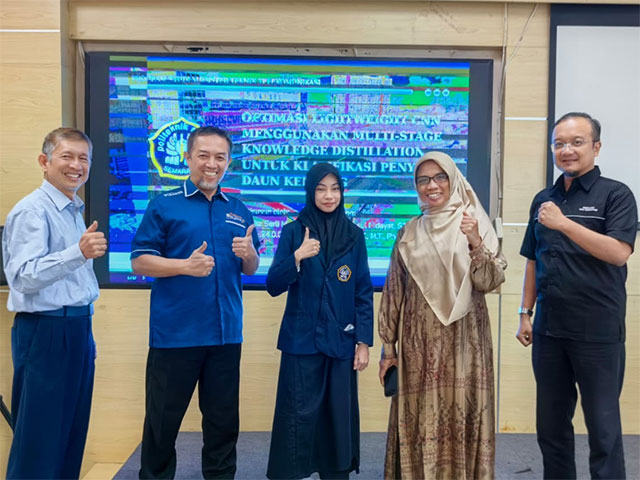
The Applied Master’s Program in Telecommunications Engineering at Politeknik Negeri Semarang held the Master’s Thesis Defense of Riska Serli Marlina on Wednesday, August 12, 2026, at the Master’s Seminar Room, second floor of the Applied Master’s Building at Politeknik Negeri Semarang. During the examination, Riska defended her thesis entitled “Optimization of Lightweight CNN Using Multi-Stage Knowledge Distillation for Potato Leaf Disease Classification.”
Riska’s research focuses on improving the performance of lightweight deep learning models for accurate potato leaf disease classification while maintaining low computational requirements. The study addresses one of the major challenges in deploying artificial intelligence on edge devices, where computing power, memory, and energy resources are typically limited.
The research utilized a dataset containing 3,076 potato leaf images acquired under uncontrolled field conditions, categorized into seven classes: Bacteria, Fungi, Healthy, Nematode, Pest, Phytophthora, and Virus. Variations in illumination, camera angles, and image backgrounds make the dataset more representative of actual agricultural field conditions.
The main approach proposed in the study is Multi-Stage Knowledge Distillation, which transfers knowledge from large-capacity teacher models to computationally efficient student models. Unlike conventional Vanilla Knowledge Distillation, which primarily transfers knowledge through the teacher model’s output probability distribution, the multi-stage approach additionally transfers feature representations extracted from intermediate layers.
To accommodate differences in feature dimensions between teacher and student architectures, the study incorporates Adapter Networks for feature alignment. The knowledge distillation hyperparameters are further optimized using the Optuna framework.
The evaluated teacher architectures include ResNet50, ResNet101, ConvNeXT-Tiny, SwinTransformer-Tiny, and SwinTransformer-Base, while MobileNetV3-Small, MobileNetV4-Small, and MobileViT-Small serve as lightweight student models.
The experimental results demonstrate that Multi-Stage Knowledge Distillation consistently improves student-model accuracy compared with both baseline models and conventional Vanilla Knowledge Distillation. The highest classification accuracy of 91.23% was achieved using SwinTransformer-Base as the teacher and MobileViT-Small as the student. The largest performance improvement was obtained using the ConvNeXT-Tiny–MobileNetV4-Small configuration, where accuracy increased by 5.52 percentage points, from 81.17% to 86.69%.
In terms of computational efficiency, the student architectures retained their lightweight characteristics. MobileNetV3-Small, for example, required only approximately 0.059 GFLOPs, while the evaluated student models achieved inference latencies of approximately 5.34–9.57 milliseconds. These findings demonstrate strong potential for further development toward deployment on edge devices for precision agriculture applications.
Riska conducted her thesis under the supervision of Dr.Eng. Ir. Sidiq Syamsul Hidayat as the Principal Supervisor and Ir. Prayitno, Ph.D. as the Co-Supervisor.
The thesis examination committee consisted of Dr.Eng. Ir. Sidiq Syamsul Hidayat as Chair of the Thesis Examination Committee, Dr. Amin Suharjono as Secretary of the Thesis Examination Committee, Dr. Eni Dwi Wardihani as Examiner 1, Dr. Muhammad Anif as Examiner 2, and Dr. Samuel Beta Kuntardjo as Examiner 3.
Through this research, artificial intelligence development is directed not only toward achieving high predictive accuracy but also toward computational efficiency and practical implementation on resource-constrained devices. The proposed approach is expected to contribute to the advancement of edge artificial intelligence and its application in precision agriculture, particularly for supporting the early identification of potato plant diseases.